The structural support for collage

Bamboo extract (silicium)

Collagen is the body’s most abundant structural protein , supporting the strength, elasticity and integrity of skin, hair, nails, bones and connective tissue. But collagen does not work alone. Silicium plays a key role in forming and stabilising collagen fibres, helping to organise and strengthen the collagen matrix within tissues.

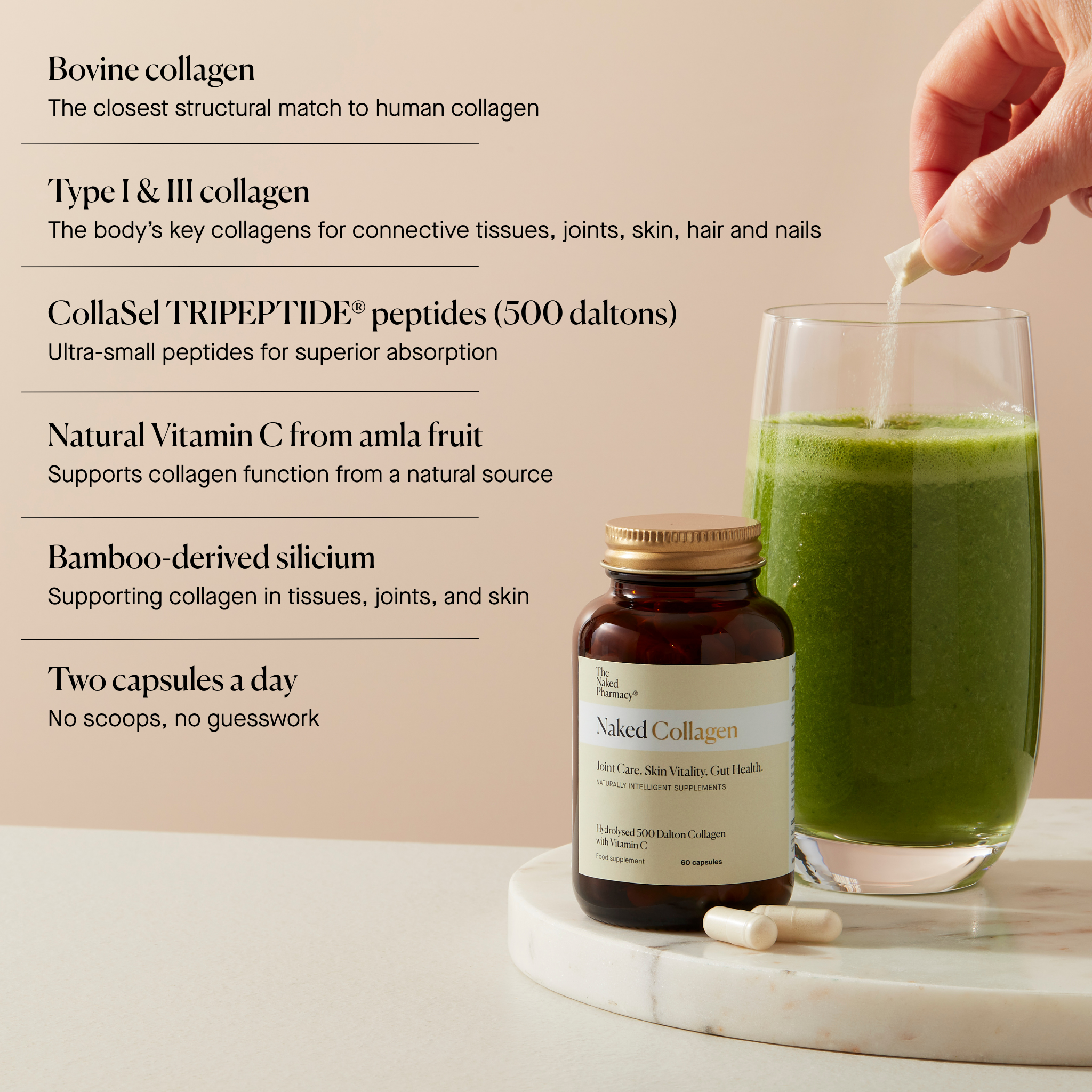
Our formula includes Bloosil® bamboo silicium, a highly bioavailable form of plant-derived silica extracted from bamboo. Bamboo is one of the richest natural sources of silicium, making it an ideal ingredient to support the body’s natural collagen production.

While collagen provides the structural framework, silicium helps strengthen and stabilise that structure, supporting the integrity of connective tissues throughout the body.

By combining collagen peptides with bioavailable bamboo silicium, Naked Collagen supports:

  • Healthy collagen formation
  • Skin firmness and elasticity
  • Strong hair and nails
  • Bone, joint and connective tissue health

A smarter approach to collagen support

  • Collagen supplementation provides the building blocks for connective tissues.
  • Silicium helps support the structural organisation and strength of those tissues.

By combining both in a single formula, this approach helps support the body’s natural collagen network more comprehensively.

What Bamboo extract (silicium) can do for you?

Skin: Supports collagen formation and helps maintain skin elasticity and firmness.

Hair & Nails: Helps strengthen hair fibres and supports stronger, more resilient nails.

Joints: Supports connective tissue integrity in joints, ligaments and cartilage.

Bone Health: Plays an important role in bone mineralisation and structural strength.

Healthy Ageing: Supports connective tissues that naturally weaken as structural minerals decline with age.

The Science

Silicium is involved in the formation and stabilisation of collagen and glycosaminoglycans, which are key structural components of skin, cartilage, bone and connective tissue.

Research suggests that silicium supports the enzymatic processes responsible for collagen synthesis, helping maintain the strength and elasticity of connective tissues throughout the body.

Dietary silicium levels can decline with age, modern food processing, and lower intake of whole plant foods, potentially contributing to the gradual weakening of connective tissue..

Silicium provides the following:

  • Support for the body’s natural collagen-building pathways
  • Helps maintain skin elasticity and structural integrity
  • Support for hair thickness and nail strength
  • Support for bone mineralisation and skeletal health
  • Support for joint and connective tissue resilience
  • Support for healthy structural ageing

Still unsure?

We’re all ears, get free expert advice from our pharmacists.

The Studies

At The Naked Pharmacy, we ensure that all of our supplements are made with effective strength bioactives, so they are clinically proven to work.

We aim for each supplement to be scientifically supported by multiple randomised placebo-controlled studies. All clinical trial studies we use to support our supplements are undertaken on human patients, using the same dosage and formulation of the product. The scientific studies are published in peer review journals.

Study: Silicon and bone health 

What was the study about:  

This paper explored whether silicon is important for bone health and connective tissue, and more specifically whether it plays a role in collagen formation, which is the structural protein that gives strength to bones, skin, and joints.

How was the study conducted: 

This wasn’t just one experiment — it was a review of multiple types of scientific studies, including:

  • Human studies (looking at bone density and markers of collagen production)
  • Animal studies (to observe how silicon affects bone formation)
  • Cell-based laboratory studies (looking at how silicon interacts with bone-forming cells)

Scientists exposed bone cells (osteoblasts) to silicon and measured things such as:

  • Collagen production
  • Enzyme activity involved in collagen synthesis
  • Cell growth and differentiation

What did the study find? 

Silicon was shown to increase type I collagen synthesis, which is the main form of collagen found in bone and connective tissue

It also increased activity of prolyl hydroxylase, a key enzyme needed to build collagen properly. In short, silicon helps switch on the body’s collagen-building machinery.

Silicon also increased osteoblast activity (bone-building cells) and production of extracellular matrix (where collagen sits). Meaning that it doesn’t just build collagen — it supports the cells that produce it.

Studies showed silicon may increase gene expression for collagen production meaning that silicon may help “turn on” the genes responsible for making collagen.

Silicon was found in high amounts in connective tissues (like cartilage and skin)

Suggesting that it may help strengthen collagen and improve structural integrity

Study: Collagen scaffolds as a tool for understanding the biological effect of silicates

What was the study about:  

The study examined how silicon (a mineral we get from food) may help support bones and cartilage in the body. Scientists already knew silicon is important for bone health, but they didn’t fully understand how it affects cells or what it does at a biological level. 

The researchers specifically looked at orthosilicic acid, which is the natural form of silicon found in the human body, and how it interacts with collagen, the structural protein that forms the framework of bones and connective tissue. 

How was the study conducted: 

Researchers created a laboratory model made from collagen combined with silicon. These special collagen structures (called scaffolds) were designed to mimic the environment where bone and connective tissue cells normally grow. 

They then placed human bone-forming cells (osteoblasts) and stem-like cells that can develop into bone cells (mesenchymal stromal cells) onto these scaffolds. 

After 48 hours, the scientists analysed the cells to see which genes were switched on or off in response to the silicon. 

What did the study find? 

The study found that silicon in the form of orthosilicic acid can influence the activity of several genes involved in bone and tissue health. 

Some new genes were identified that appear to respond to silicon, including TNF (tumour necrosis factor), which is involved in cell signalling and inflammation.

Overall, the results suggest that silicon interacts with collagen and bone cells at a genetic level, helping regulate processes involved in musculoskeletal tissue health.

The researchers also found that their collagen–silicon scaffold model could be a valuable tool for studying how silicon supports bones and connective tissue.

Glossary of terms:

There are a few key terms to be aware of when reviewing these studies:

Randomised Clinical Trial

A clinical trial in which the participants are assigned randomly (by chance alone) to different treatments.

Double-blind study

A study in which neither the participants nor the experimenters know who is receiving a particular treatment. This procedure is utilised to prevent bias in research results.

Double-blind studies are particularly useful for preventing bias due to demand characteristics or the placebo effect.

P-value

The probability of obtaining the observed results of a test. The lower the p-value is, the more confident we can be of a true result. For example, a p- value of 0.001 confirms a result as 99.9% accurate.

Placebo

An inactive treatment used in a clinical trial, sometimes referred to as a “sugar pill”.

A placebo-controlled trial compares a new treatment with a placebo, in order to give greater confidence that the result is only due to the test/active ingredient.